
Industrial Fumigation Services
Safe, audit-ready treatments for warehouses, silos, containers & mills—scheduled around your operations.
Pakistan Fumigation delivers industrial fumigation that fits real production schedules and export timelines. Whether you run a food plant in Karachi, a logistics warehouse in Lahore, or a grain stack at an inland facility, our teams plan treatments to minimize downtime while maintaining strict safety controls. You get clear steps, transparent monitoring, and post-treatment documentation—so your QA, HSSE, and export partners have what they need.
Call/WhatsApp: +92 331 8496210 • Address: C-40, Bantva Nagar, Liaquatabad Town, Karachi (public)
At-a-glance
- Nationwide service coverage (Pakistan) with strong presence in Karachi & Lahore
- Warehouse, container, mill, and grain-stack fumigation
- ISPM-15 support for wooden packaging (treatment + documentation guidance)
- Emergency visits for active infestations (subject to site safety)
Who this page is for
- Exporters & 3PLs needing container fumigation and quick turnaround at Karachi Port/Port Qasim or Lahore dry port.
- Food & grain operators managing stored-product pests in warehouses, silos, and mills.
- Factory & pharma teams scheduling shutdowns with QA/HSSE oversight and audit requirements.
What Is Industrial Fumigation & When It’s the Right Choice
What industrial fumigation means
Industrial fumigation is a sealed-space gas treatment used to control pests hidden deep inside commodities, packaging, machinery voids, or building cavities. Unlike sprays or surface dusts, fumigants penetrate into stacks, pallets, and crevices—making them a preferred option for stored-product insects (SPIs) like beetles, weevils, and moths. Because fumigants are hazardous, treatments follow a strict safety plan: area evacuation, sealing, dosage calculation, monitoring, exposure period, and controlled aeration before re-entry.
When to use fumigation
- Export readiness: Containerized cargo at Karachi Port/Port Qasim or Lahore dry port that must meet import requirements, with monitoring logs and a clearance note.
- Food plants & mills: Periodic shutdowns for whole-area treatment of production halls, silos, or raw-material warehouses.
- Grain stacks & godowns: Tarpaulin-sealed stacks of rice, wheat, or pulses where insects are active inside the commodity itself.
- Wood packaging: Pallets/crates needing treatment prior to overseas shipment.
When fumigation is not ideal
- Open, unsealable spaces: Consider IPM instead of gas treatment.
- Rodent-only problems: Structural proofing, trapping, and sanitation outperform fumigation here.
- Sensitive production windows with no downtime: Plan a staged IPM approach first, then schedule fumigation during an agreed shutdown.
Services We Offer
Warehouse & mill fumigation
For food, beverage, packaging, and distribution facilities, we plan warehouse-wide or zone-specific fumigations during off-hours or scheduled shutdowns. The focus is on sealing quality (doors, vents, dock gaps) and commodity coverage so gas concentration stays within target ranges for the full exposure period. Our teams coordinate with your QA and HSSE to define evacuation zones, signage, and re-entry criteria—so your supervisors can control the handover confidently.
In Karachi and Lahore, we commonly treat mixed environments (finished goods plus raw materials). We segment areas where needed, protect sensitive equipment per manufacturer guidance, and log monitoring readings so you have a defensible record during audits.
Learn more on our Warehouse Fumigation page.
Silo or grain-stack fumigation
For silos and tarpaulin-sealed stacks (rice, wheat, pulses), success hinges on gas-tight sealing and temperature considerations. We survey the enclosure, specify tarpaulin and sand-snake sealing (where applicable), and plan exposure times that reflect the pest species and commodity conditions.
In central and southern Pakistan, seasonal heat can accelerate pest life cycles—so we pair fumigation with follow-up inspections and practical housekeeping measures (spillage control, waste rotation, sieve cleaning) to reduce re-infestation pressure.
Container fumigation
For exporters, we align with port/dry-port windows to keep containers moving. Typical steps include: pre-seal inspection, dosage application, container sealing, monitored exposure, controlled aeration, and clearance note issuance. We brief your freight forwarder on timing so the unit does not miss the cut-off.
Common cargo we handle includes rice, pulses, spices, seeds, paper/packaging, and textiles. Where an importer requests specific paperwork, we integrate those notes in your documentation pack (see below).
ISPM-15 support for wooden packaging
If your shipment involves wooden pallets, crates, or dunnage, we can provide treatment and documentation guidance aligned with ISPM-15 expectations. Because requirements vary by destination and authority, we avoid over-promising; we outline what our treatment and paperwork do and do not cover, and advise on any additional steps your shipper or importer may request.
Emergency infestations & rapid response
Active insect pressure in a warehouse or a container close to cut-off can disrupt orders. Our rapid survey identifies the scope (commodity, volume, temperature, sealing feasibility) and proposes containment plus treatment steps that fit your safety constraints. Emergency work is always subject to safe evacuation and regulatory requirements; where same-day fumigation isn’t safe or feasible, we stabilize the situation and schedule the earliest safe window.
Industries We Serve
Food & beverage processing
Food plants need treatments that respect hygiene zones, QA sampling, and shift patterns. We coordinate fumigation during scheduled shutdowns or windowed night operations so production can restart with a clean handover. Packaging lines, raw-material stores, and finished-goods areas are evaluated separately because sealing quality and residual risk differ across zones. We also align documentation with what auditors typically ask for: scope, monitoring readings, aeration steps, and a clear re-entry note tied to time and responsible person.
In Karachi and Hyderabad corridors, ambient heat and humidity can speed up stored-product insect life cycles, increasing pressure on rice, flour, and spice inventories. For beverage plants, sugar and flavoring stores often sit near packaging—so we recommend segregation and better pallet discipline after fumigation to reduce re-infestation. Where glass or sensitive machinery is present, we protect and label critical assets as part of the safety plan. Your QA receives a briefing note in plain language so supervisors can explain the activity to line staff confidently.
Grain storage & mills
Silos, godowns, and mill annexes face deep-seated infestations that sprays can’t reach. We begin with commodity temperature and moisture checks, then plan sealing—tarpaulins and sand-snakes for stacks, gasket evaluation for silos. Exposure time and monitoring intervals are matched to pest type and conditions, because under-dosing or poor sealing only creates resistance and callbacks. Post-treatment, we advise on screening, spillage cleanup, and sifting schedules to keep pressure down between cycles.
In Punjab and interior Sindh, seasonal peaks call for calendarized interventions. Mills often coordinate with their maintenance shutdowns; we integrate fumigation tasks into that same window to minimize downtime. Where mixed commodities share a shed—say, rice and pulses—the plan may split stacks by risk and seal integrity. If your buyer demands proof of treatment pre-shipment, we ensure the documentation pack references lot identifiers for traceability.
Packaging, printing & paper stores
Paper reels, cartons, and printed packaging can harbor pests introduced from suppliers’ warehouses. While commodities aren’t edible, infestation can still cause costly rejections when packaging travels with food exports. We focus on enclosure preparation and micro-leak control along dock doors and floor joints. After clearance, we typically propose improved racking gaps, FIFO discipline, and routine inspection checkpoints as part of a light IPM layer.
Karachi’s coastal air can complicate sealing because of persistent drafts; we account for this in the sealing assessment and monitoring plan. For plants that must keep sample rooms or QA labs accessible, we either exclude those spaces or schedule them in a separate mini-window. The goal is simple: restore a pest-free packaging pipeline without stalling press time or dispatches.
Pharma, nutraceuticals & personal care
Regulated environments demand elevated controls, from MSDS availability to sign-offs before re-entry. We coordinate with QA and HSSE to define a restricted-access zone, protect critical utilities, and confirm air-change rates for safe clearance. Because many pharma sites operate with stringent documentation, we align our reporting with their audit trails—timestamps, responsible personnel, monitoring points, and final clearance confirmation.
In Lahore’s industrial estates and Karachi’s Korangi/FB Area clusters, many pharma warehouses sit in mixed-use buildings. We add extra signage and perimeter control to prevent accidental entry by neighboring units. If a production line cannot be paused, we recommend a staged approach: segment non-critical storage now, then incorporate the line area during a planned outage.
Textiles, garments, logistics & 3PL
Textile and garment exporters often need container turnaround without disrupting finishing or packing. We prioritize access, safe staging areas, and efficient handovers that mesh with cut-off times. In 3PL settings with multi-client inventory, zoning becomes essential so one client’s risk doesn’t spill into another’s bay. We map bays, allocate buffer aisles, and run a communication plan to keep multiple stakeholders aligned.
Dry ports and bonded warehouses have their own procedures; our team adapts to those rules instead of pushing one generic template. If your buyer specifies destination-country notes in the paperwork, we add them to the documentation pack. The objective is operational continuity: get cargo cleared, keep bays turning, and leave a paper trail that satisfies partners across the chain.
Pests & Commodities We Treat
Stored-product insects (SPIs): beetles, weevils, moths
SPIs thrive inside grain kernels, flour dust, and spice packs, making penetrative gas treatment more effective than surface methods. Wheat, rice, pulses, nuts, and spices are the highest-risk commodities, particularly where temperature and moisture favor rapid breeding. For mixed inventory, we survey each commodity and group them by risk and sealing feasibility. This ensures dosage and exposure are appropriate across stacks, not averaged in a way that under-treats tougher pockets.
In Pakistan’s climate, populations can rebound quickly if sanitation and stock rotation slip. After fumigation, we recommend practical housekeeping: remove spillage, vacuum dust accumulations, rotate slow-moving SKUs, and inspect incoming lots. These simple steps multiply the longevity of the treatment and help prevent resistance buildup. Where feasible, we schedule follow-up checks to catch early signs before they escalate.
Wood-borers and wood packaging
Wood-borers compromise pallets, crates, and dunnage, which can trigger export delays. Fumigation can be part of the response, but success depends on thorough sealing and sufficient exposure. We explain exactly what our treatment covers and where additional steps—like compliant heat treatment or specific destination requirements—may apply. The goal is a documented, defensible approach rather than one-line claims that create false confidence.
For shippers consolidating at Karachi or Lahore, mixed packaging sources can introduce variability. We advise standardizing pallet suppliers, inspecting incoming wood, and isolating suspect material for treatment. After clearance, we tag and record treated batches so warehouse teams can identify compliant units at a glance. This reduces confusion during stuffing and helps freight forwarders move containers without rework.
Occasional invaders & secondary issues
Some pests arrive via supplier trucks or adjacent facilities and don’t colonize commodities deeply. Here, fumigation may still be selected if the risk envelope includes hidden larvae or inaccessible voids. Otherwise, we propose targeted IPM—proofing gaps, improving door discipline, and local treatments that won’t halt operations. The decision is always based on biology, risk, and practicality, not a one-size-fits-all script.
Sensitive products, such as certain additives or packaging films, may need special protection steps. We identify and shield these items during preparation, or temporarily relocate them where safe. After the job, we provide handling notes for staff to avoid re-introducing pests through incoming pallets or returns. Simple measures like dedicated quarantine zones and supplier scorecards go a long way.
Our Process
1) Survey & sealing assessment
Every successful fumigation starts with measurement: volume (m³), commodity type, infestation level, and temperature. We walk the site to map air-leak paths—dock doors, floor joints, vents—and note obstacles that hinder sealing. For stacks, we specify tarpaulins, sand-snakes, and tape systems; for silos, we check hatches and gaskets. The site survey concludes with a written scope, proposed exposure time, and a preparation checklist for your team.
Preparation isn’t busywork—it’s the difference between full-kill and wasted effort. We help you prioritize tasks that deliver the biggest sealing gains in the least time, such as blanking unused vents or patching torn tarps. If operations must continue in adjacent bays, we design a cordoned exclusion zone with clear signage. The result is a practical plan your supervisors can execute without guesswork.
2) Safety plan & site readiness
Fumigants are hazardous, so controls are non-negotiable. We establish evacuation boundaries, lock-out procedures, and emergency contacts; we also position warning signs at all entry points. PPE requirements are briefed to our team and your nominated representatives. Sensitive assets get protected, utilities are checked, and a last-look inspection confirms readiness before application.
Communication reduces risk. We share a single-page schedule showing start time, exposure checkpoints, and expected aeration. Shift leaders get talking points for their teams so no one crosses barriers or tampers with seals. If conditions change—weather, access, or unexpected leaks—we pause and correct before proceeding. Safety is the only timetable we won’t compress.
3) Dosage calculation & application
Dosage isn’t a guess; it factors enclosure volume, pest species, commodity, and temperature. We apply fumigant using approved equipment and techniques that deliver even distribution. Seals are checked immediately after application to prevent early gas loss. We log start time and conditions so monitoring data later has context.
Application is only half the equation—holding concentration is the other half. Where we suspect micro-leaks, we reinforce seals and plan more frequent checks. If multiple enclosures are treated, we sequence them to maintain quality control rather than rushing all at once. The aim is consistent, provable exposure that leads to reliable results at clearance.
4) Monitoring & mid-course corrections
Monitoring tells us whether concentration remains in the effective range. We schedule readings at defined intervals and record them in a log your QA can keep. If levels dip prematurely, we troubleshoot: improve sealing, adjust exposure, or, where safe and appropriate, re-dose according to plan. All changes are documented so the audit trail stays intact.
Transparent data calms stakeholders. Supervisors see that progress is measured, not assumed. In multi-tenant warehouses or large mills, we stagger checks so production or security teams aren’t pulled away from critical tasks. If anything jeopardizes safety or efficacy, we stop and resolve before moving to the next stage.
5) Aeration, clearance & handover
At exposure completion, we initiate controlled aeration—opening defined points to vent gas while maintaining exclusion zones. We measure residual levels until they meet re-entry criteria, then record time and responsible person granting clearance. Only after clearance is confirmed do we remove barriers and signage. Your team receives a verbal briefing so the area re-opens in an orderly way.
Clearance is more than a number; it’s a procedure. We ensure fresh-air exchange is adequate, check that sensitive areas are safe to occupy, and verify that prepared commodities or equipment can be handled without additional restrictions. If your buyer or authority requires specific phrasing in the clearance note, we incorporate that into the document pack where appropriate. This avoids last-minute paperwork delays.
6) Documentation pack
You receive a neat, audit-ready file: scope of work, job card, dosage and exposure plan, monitoring log, corrective actions (if any), aeration steps, and a clearance/“gas-free” note for re-entry. Where shipments are involved, we add exporter-support notes referencing container numbers, lot IDs, or destination requests. Photos may be included when permitted by site rules to corroborate sealing and signage. Everything is written in clear, practical language.
Documentation reduces repeated questions from QA, HSSE, buyers, and freight partners. When your next audit comes, the file shows that risk was identified, controlled, verified, and signed off. If future treatments are needed, this record shortens planning time because everyone understands your site’s realities.
Safety & Compliance
Technician competence, PPE & supervision
Industrial fumigation is hazardous work; we only proceed with trained technicians under a named supervisor. Before application, the supervisor verifies PPE, signage, lock-out of access points, and emergency contacts. A short toolbox talk aligns our team with your QA/HSSE leads on evacuation boundaries, radios/phones to be used, and who can authorize each stage. If anything changes during the job—weather shifts, unexpected access needs, or sealing failures—we pause and correct before continuing.
Site control, signage & perimeter management
We place warning signage at every potential entry, including rear fire doors, loading docks, and stair access to mezzanines. Where facilities share boundaries with other tenants (common in Karachi’s industrial clusters), we extend signage to shared corridors and inform your neighbors through the nominated focal person. Barriers are physical (tape, cones, portable fencing) and procedural (keys with the supervisor; do-not-operate tags on shutters). No one re-enters until clearance is recorded and communicated.
Handling sensitive environments
Food and pharma sites demand tighter controls. We coordinate with QA for pre-treatment protection of sensitive zones and establish a sampling plan for the post-clearance period when required by your procedures. For healthcare-adjacent sites, we factor in patient pathways and visitor traffic; if a safe perimeter cannot be guaranteed at the proposed time, we reschedule. MSDS and risk assessments are available on request, and we keep a copy in the site file for your audit trail.
Product integrity & residue considerations
Fumigants act in the gaseous phase and are applied to sealed enclosures to reach hidden insects. After exposure, controlled aeration reduces gas to safe re-entry levels before handover. Because products, packaging, and regulatory thresholds differ, we avoid blanket claims—your clearance note will state objective measurements and time stamps rather than promotional language. Where a buyer or authority requires specific wording, share it during planning so we can align the document phrasing where appropriate.
Documentation You Receive
What’s inside the audit-ready pack
- Scope & job card: site details, enclosure descriptions, volume (m³), commodity/area treated, responsible persons.
- Dosage & exposure plan: target concentration, planned exposure time, assumptions (temperature, sealing notes).
- Monitoring log: interval readings, instruments used, corrective actions if concentration dipped.
- Aeration & clearance note: re-entry criteria, final measurement(s), date/time of clearance, named supervisor.
- Attachments where permissible: photos of sealing, signage, meter screenshots, container numbers/lot IDs, and any destination notes requested by the buyer/importer
Export & container-specific paperwork
For exporters at Karachi Port/Port Qasim or Lahore dry port, your pack can include: container ID(s), seal numbers (if applied post-aeration), exposure and clearance timeline, and an exporter-support note that references the shipment or PO. Because acceptance criteria vary by destination or buyer, we align with any provided template where it fits the facts of the job. If a requirement falls outside our scope, we state it plainly so you can coordinate with your shipper or freight forwarder.
How documentation reduces future downtime
A good file saves future hours. When the next audit comes—or when you repeat the treatment—teams can reuse the same risk controls and monitoring intervals that worked, instead of reinventing the plan. It also shortens sign-off cycles with buyers and insurers because the evidence is organized, dated, and attributable.
Scheduling & Downtime Planning
Pre-survey to clearance: a practical timeline
- Initial call/WhatsApp: you share location, commodity, approximate volume (m³), and urgency.
- Site survey: we confirm sealing feasibility, temperature, access constraints, and prepare your preparation checklist.
- Preparation window: your team executes the checklist—clearing aisles, isolating sensitive goods, closing vents.
- Application & exposure: our team applies dosage and monitors at set intervals.
- Aeration & clearance: controlled ventilation until re-entry criteria are met; we brief your supervisors and remove barriers.
Coordination with shift work & multi-tenant sites
Three-shift operations need transparent communication. We provide a one-page event schedule for notice boards and WhatsApp groups so every shift knows when exposure begins, who holds the keys, and when clearance is expected. In multi-tenant warehouses, we define buffer aisles and agree on who escorts security or third-party visitors. If a neighbor’s operation prevents safe isolation during the planned time, we adjust rather than risk a perimeter breach.
Seasonality, weather & special calendars
Pakistan’s climate and business calendar matter. Monsoon winds can challenge tarpaulin seals; we plan extra checks and sand-snake reinforcement. During Ramadan or Eid holidays, we often schedule larger jobs to match reduced production. Heat waves demand attention to commodity temperature and worker safety—if conditions jeopardize efficacy or safety, we shift the window and explain why.
Aftercare & return-to-operations checklist
After clearance, your team receives a reopening checklist that covers: staged removal of signage, re-powering equipment if it was isolated, waste/spillage cleanup, and inspection of incoming loads that could reintroduce pests. We also recommend practical IPM add-ons (housekeeping points, dock-door discipline, supplier inspection) to extend the treatment’s life without slowing operations.
Pricing
Drivers that increase or decrease cost
- Volume & complexity: total m³, number of enclosures, and whether treatment is a single sealed room, multiple stacks, or silos.
- Sealing quality: good seals reduce gas loss and retouches; poor seals increase preparation time and monitoring intensity.
- Commodity & pest profile: high-risk commodities (e.g., rice, pulses, spices) and resistant pest pressures can require longer exposures.
- Documentation depth: standard pack vs. export-detailed logs with container numbers, photos, or buyer-specific notes.
- Access & timing: after-hours, weekend/holiday windows, or port-coordinated jobs typically cost more to staff safely.
- Travel & logistics: outside Karachi/Lahore or multi-site rollouts add mobilization time and accommodation where needed.
- Urgency: emergency mobilizations are possible when safe; if not, we stabilize and move to the next feasible window.
What we won’t do
We don’t publish a one-size price or claim “guaranteed 24-hour turnaround” because responsible fumigation depends on your site’s realities—sealing, commodity, temperature, access, and buyer requirements. If a competitor promises an exact time or outcome without surveying, ask which exposure assumptions they’re using and how they’ll verify gas concentration. Reliable quotes come from measured scopes, not slogans.
Getting a firm quote in hours
- Share site address, enclosure type(s) (warehouse room, silo, stack, container), and approx. m³.
- Identify the commodity and any export/buyer paperwork requirements.
- Tell us your deadline (port cut-off, production restart) and preferred work window.
- Send photos or a short video of the area/stacks/doors if a same-day visit isn’t possible.
Why Pakistan Fumigation
- Local expertise, national reach: Karachi-headquartered with capability to serve Lahore, Islamabad, and major industrial clusters.
- Industrial focus: warehouses, mills, containers, and silos—not just residential jobs.
- Transparent process: survey, safety plan, monitored exposure, documented clearance—no shortcuts.
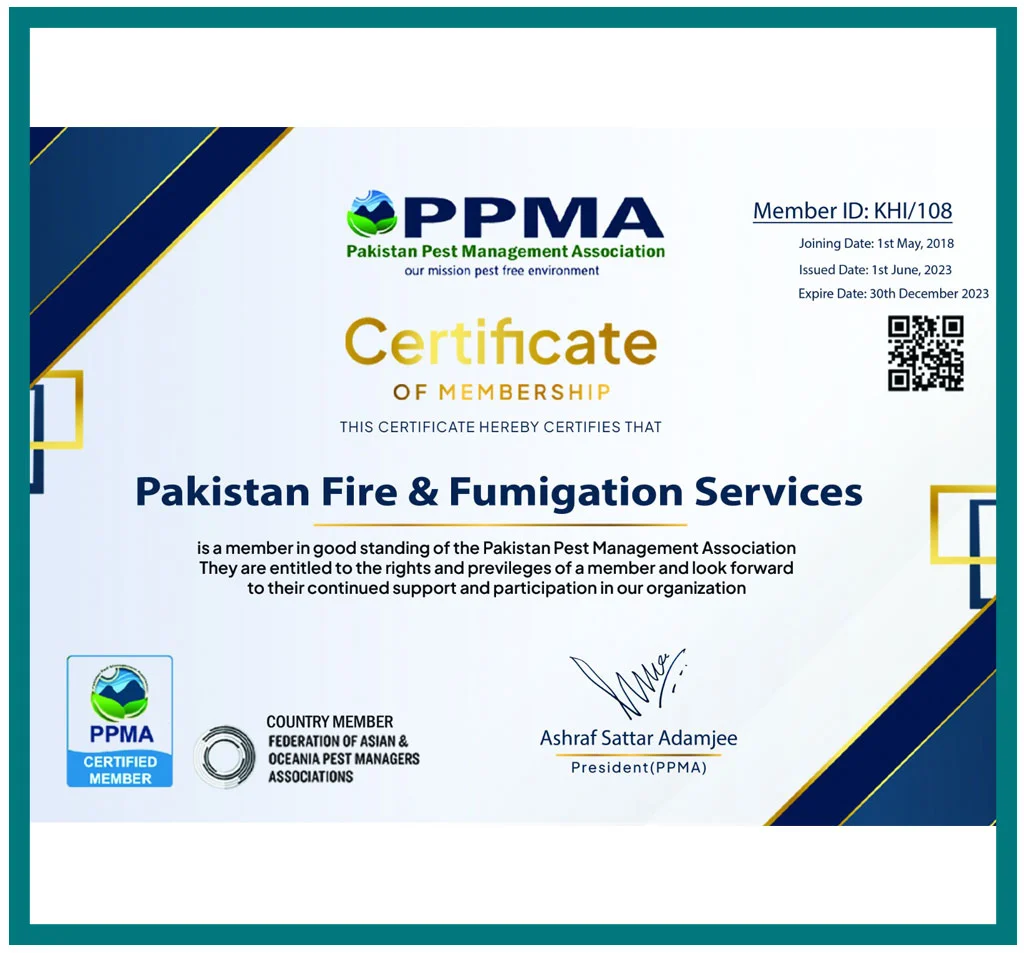
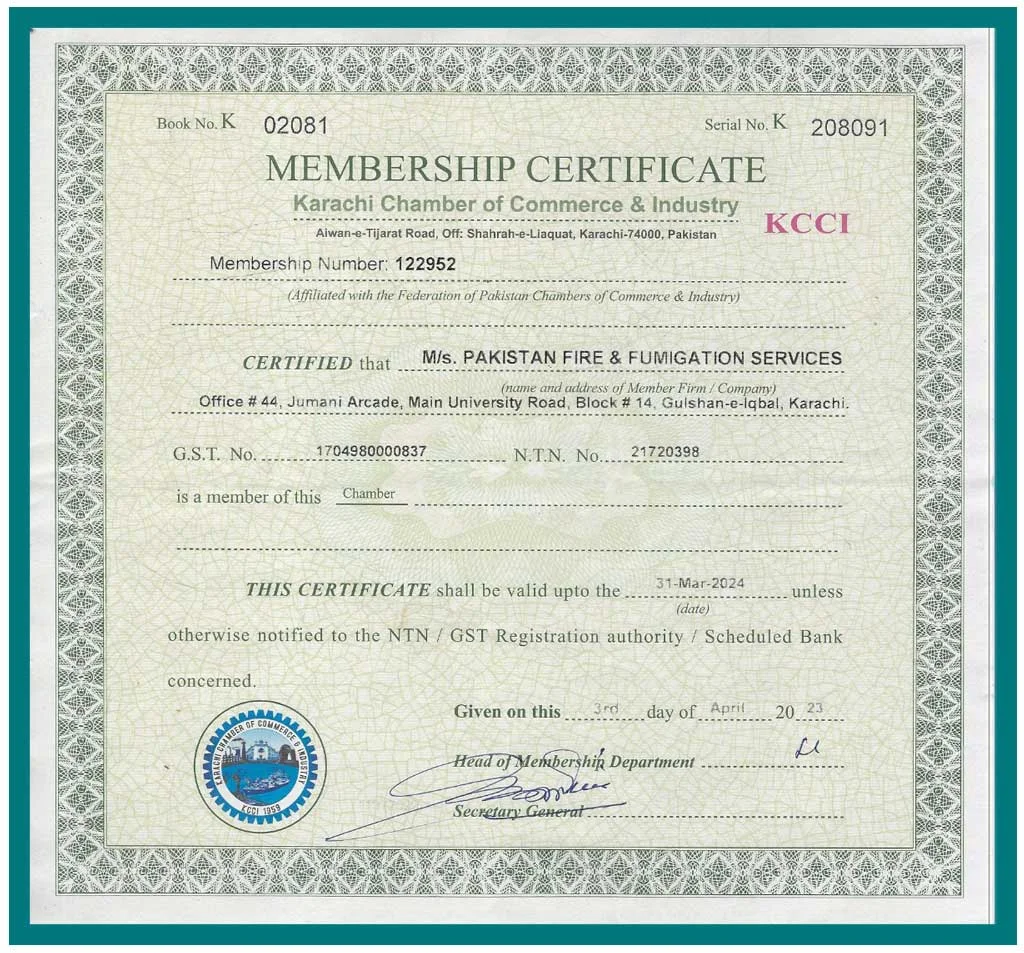
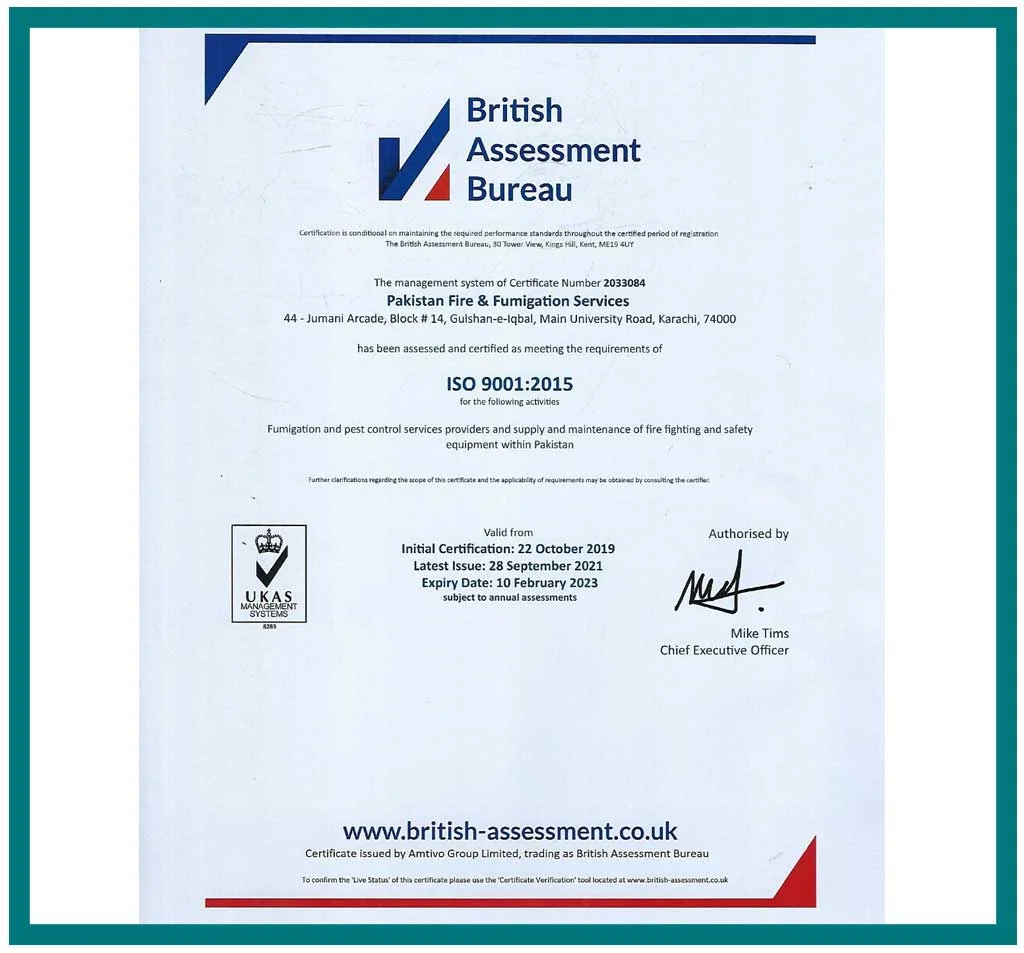
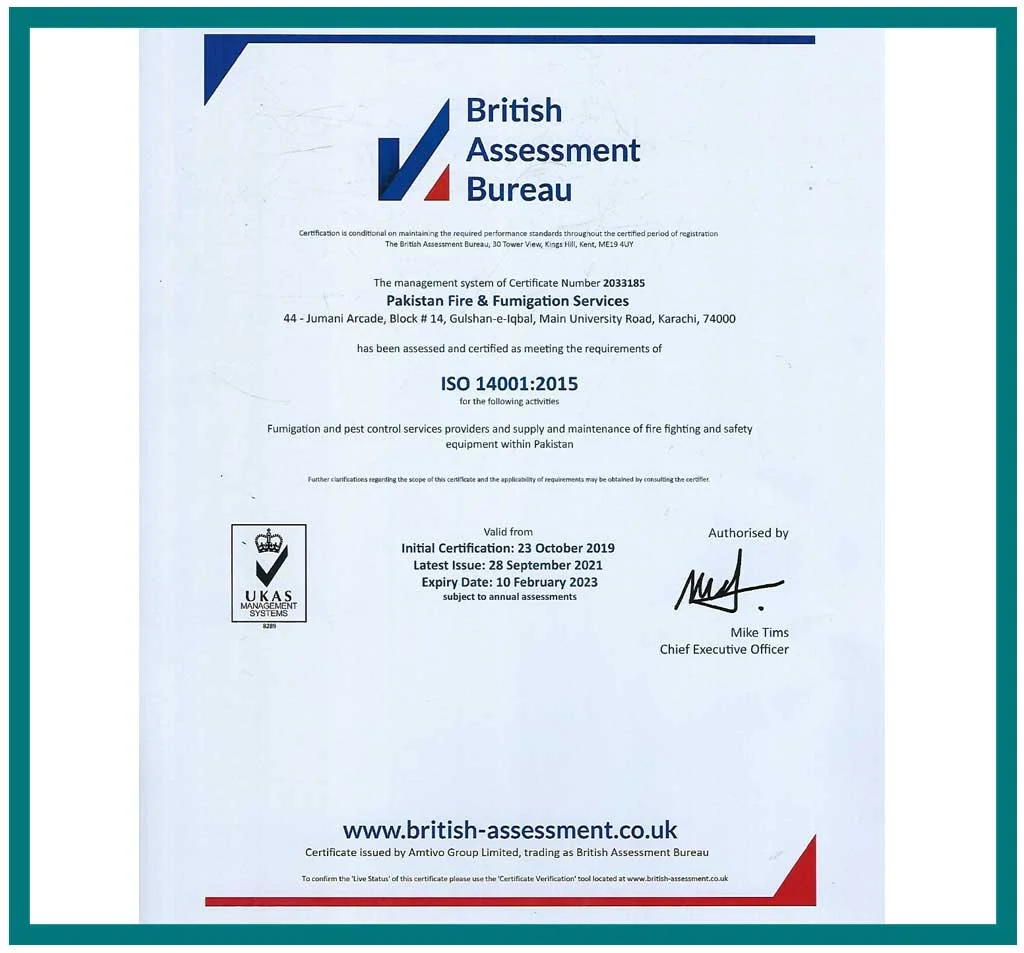
- Audit-ready documentation: files that your QA, HSSE, buyers, and auditors can follow without rework (see Certificates).
- Flexible scheduling: night/weekend windows and port-aligned slots to protect production and export cut-offs.
- Integrated IPM: pairing fumigation with IPM services for longer-term control.
- Full portfolio: explore related solutions on our Services page and dedicated Warehouse Fumigation page.
All Services
Call Us Today
(+92) 331 8496210
We offer pest control services for individuals, businesses, and corporations. Contact us for a free inspection.
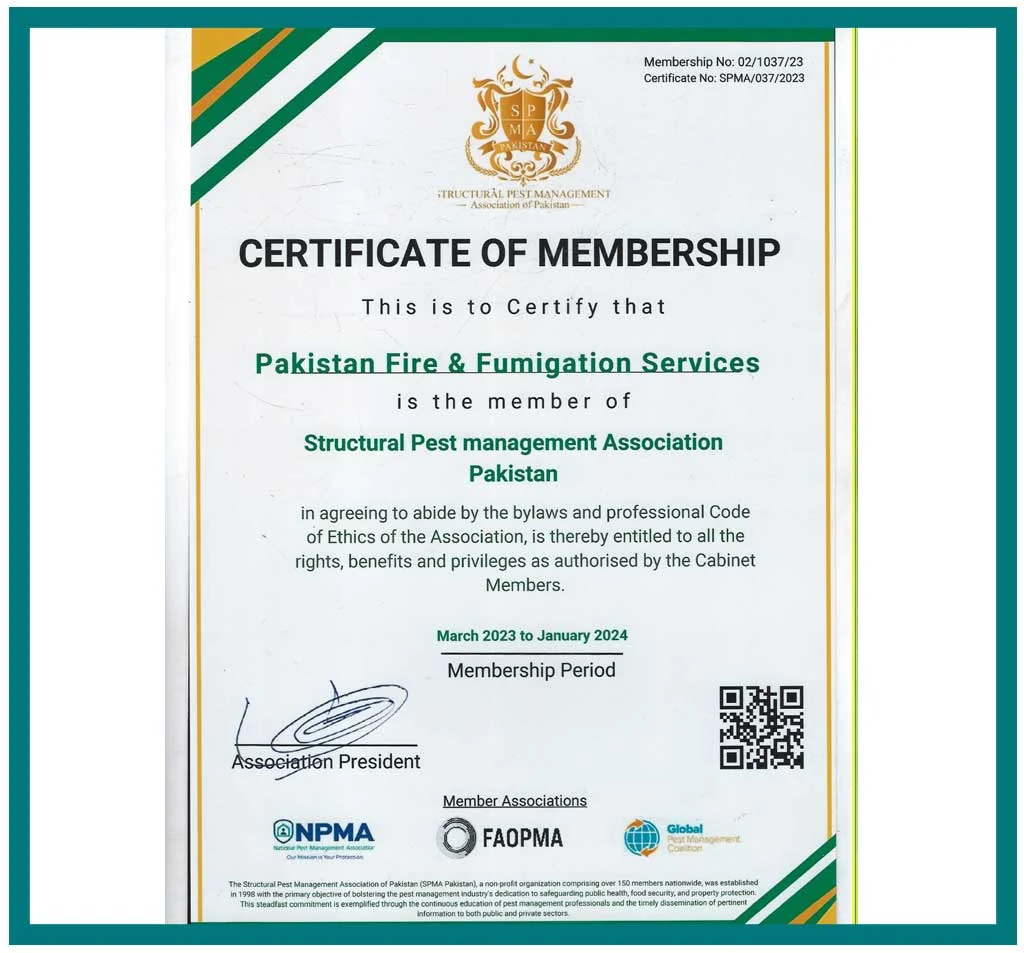
Our Certificates
What Our Clients Say
Muhammad Abdullah — 2022-06-02
Pakistan Fire & Fumigation is one of the best companies, offering mind-blowing customer service across Pakistan.
NAJAM ISLAM — 2022-06-02
Best fumigation in the town i must sayyy
Anas Amir — 2022-06-04
I have tried their fumigation service and hands down they are the best in karachi.
Javed Khan — 2022-06-05
Expert teams and very cooperative staff best work done in my house
Rafay Paracha — 2022-06-06
Best fumigation servies in Karachi! One should really try their services for a healthier environment.
Ahmed Shah — 2022-06-01
Best fumigation in town, I must say!