Fumigation Services for Hospitals
Hospital Fumigation Services in Pakistan
Pakistan Fumigation provides hospital fumigation and targeted disinfection for OTs, ICUs, isolation rooms, wards, diagnostic areas, and administrative spaces. Our teams schedule work around operating theatre lists and clinic hours to minimize disruption. From Karachi to Lahore and Islamabad, we coordinate closely with infection control and biomedical teams so sensitive equipment, negative-pressure rooms, and HVAC settings are handled exactly as your SOPs require.
Every job begins with a risk assessment and ends with a clear handover: treated-area map, chemical list, Safety Data Sheets (SDS), and re-entry guidance. We do not claim to sterilize medical instruments (that remains CSSD’s scope). Instead, we decontaminate rooms and structural areas, apply residual protection where appropriate, and integrate pest control measures that prevent re-infestation.
Call: +92 331 8496210 | Service: Hospital fumigation, OT fumigation and sterilization support (room-level), ICU fumigation and disinfection, and whole-facility programs.
Why hospitals choose Pakistan Fumigation
Hospitals engage us for consistent coordination, medically cautious methods, and documentation that satisfies internal audits and third-party accreditors. We deploy trained technicians with appropriate PPE, use hospital-grade disinfectants and approved insecticides, and schedule re-entry based on room volume and ventilation—not a fixed guess. Our integrated approach reduces downtime, supports infection-control goals, and addresses the real-world pest vectors commonly seen across Pakistani healthcare facilities.
Who We Serve & Where
We serve tertiary hospitals, private medical centers, standalone clinics, day-surgery and dental suites, diagnostic laboratories, dialysis and oncology units, pharmacies, nursing homes, and rehabilitation facilities. Each site type has different risks: for example, dental operatories require careful coverage of chair-mounted devices; isolation rooms demand strict door signage and aeration checks; laboratories often need special handling for specimen areas. We tailor the method statement to your environment, equipment sensitivity, and maintenance window.
Coverage: Karachi (rapid response) with scheduled projects in Lahore, Islamabad, and other cities across Pakistan. For multi-site hospital groups, we align treatment calendars and documentation formats so your internal reporting stays consistent across locations.
Use cases across departments
Operating theatres (OT): Scheduled after maintenance, renovation, or deep cleaning—room sealing as needed, surface-compatible protocols, and re-entry signed off with the OT manager.
Critical care (ICU/HDU/NICU/PICU): Focus on high-touch zones and structural voids; special caution around incubators, ventilators, and monitoring equipment.
Wards, ER/OPD, labs, pharmacies, CSSD corridors, and admin areas: Targeted decontamination and pest control with minimal odour and residue, plus proofing recommendations to prevent recurrence.
What “Hospital Fumigation” Includes
Hospital fumigation is not a single action; it’s a bundle of room decontamination and pest-risk reduction steps designed for clinical environments. Below is the typical scope—final details depend on your facility layout, HVAC, and SOPs.
OT fumigation and theatre prep: Post-maintenance fumigation and disinfection of walls, ceilings, floors, lights, pendant arms, and fixed cabinetry as applicable. We coordinate with your engineering team on AHU status and filter protection. Instruments remain CSSD-only; we do not handle sterile packs.
ICU fumigation and disinfection: Room-level fumigation and targeted disinfection around bed spaces, nurses’ stations, and medication prep areas. Lines, vents, and sensitive devices are shielded as required by your biomedical team.
Isolation and negative-pressure rooms: Strict entry control, clear warning signage, and controlled aeration. Re-entry windows are set after calculating product dwell time, room volume, and air changes per hour (ACH).
Clinics & diagnostics: Consultation rooms, dental operatories, radiology waiting areas, phlebotomy bays, and sample handling rooms. We adjust application modes to protect imaging and chair-mounted equipment.
Supporting zones: CSSD corridors, clean/dirty utility rooms, storage areas, waste holding rooms, back-of-house corridors, canteens, and loading bays—because pests travel through these routes to reach patient areas.
Hospital pest control integration: Alongside fumigation or misting, we address insect harbourages and rodent ingress with targeted baits, gels, and proofing notes so your environment remains stable between cycles.
What we don’t include
We do not sterilize medical instruments or claim sterility of packs (that is CSSD jurisdiction). We avoid deprecated, high-toxicity methods in occupied healthcare settings. We won’t apply residuals where your policy forbids them (e.g., on open clinical worktops). These boundaries protect patients, staff, and equipment—and keep your audits straightforward.
Methods & Materials (IPM-led)
Our approach is Integrated Pest Management (IPM)—prevention and monitoring first, targeted chemistry second. Where possible, we combine non-chemical controls, structural proofing advice, and precise placements so you get longer-lasting results with less disruption.
Application modes: ULV cold fogging or fine misting for room-level disinfection, space fumigation where appropriate, residual microencapsulated sprays in approved zones, gel baits for cockroaches/ants, and secured rodent stations in non-clinical perimeters. Each mode is chosen after the site survey and risk assessment, not by a one-size template.
Chemicals and documentation: Only hospital-grade disinfectants and approved insecticides are used. The completion pack includes the product list, batch references if required by your policy, and SDS for your records. Re-entry is guided by measured dwell time and ventilation—communicated in writing to the department in charge.
Equipment compatibility: Before treatment we identify sensitive assets (e.g., anaesthesia machines, endoscopy towers, microscopes) and apply covering/sealing protocols that match your SOP. We coordinate with biomedical and housekeeping to reduce downtime and protect warranties.
For background on our general fumigation techniques used outside clinical areas, see Fumigation Spray. To understand our prevention-first philosophy, visit IPM Services.
Step-by-Step Process: What to Expect
Pre-Survey & Risk Assessment
Every hospital engagement starts with a structured pre-survey. Our supervisor walks the space with your infection control lead, OT/ICU in-charge, and facilities team to map room volumes, ACH (air changes per hour), HVAC status, and sensitive assets. We record zone types (OT, ICU, isolation, wards, labs), traffic patterns, and downtime windows so the method statement fits your realities—not an idealized schedule. Pest activity is identified through visual checks, staff interviews, and evidence such as droppings, smear marks, harbourage points, and drain ingress. This baseline gives us a defensible plan that your administration can approve without guesswork.
The risk assessment translates findings into clear do/don’t guidelines for our team and yours. We specify which equipment needs covering or removal, which vents must be closed or left on, and what signage is mandatory at each doorway. Chemical selections are pre-approved with your designated authority, with SDS prepared for handover. If any area carries a special risk—such as NICU incubators or endoscopy towers—those are addressed with additional controls or treated as exclusion zones.
Treatment-Day Execution
On the day, our crew arrives in PPE and signs into your contractor log, after which we brief the department about zone closures, estimated dwell times, and re-entry criteria. We place caution boards and barrier tapes, isolate the target rooms, and verify that prep tasks are complete before any application begins. ULV misting or cold fogging is used for room-level disinfection; space fumigation and residual treatments are applied only where policy allows and only after sensitive surfaces are protected. Harborage controls—gel baits in cracks/crevices and secured rodent stations in non-clinical perimeters—are installed to intercept pest vectors between service cycles.
Technicians record start/stop times, product volumes, nozzle settings, and coverage patterns so documentation aligns with your audit needs. In OTs, we coordinate with the theatre manager on AHU status and re-start timing. In ICUs and isolation rooms, we double-check airflow direction, pressure differentials where applicable, and door discipline. For multi-room projects, our lead tech runs a live tracker to stagger rooms so parts of the facility can return to service sooner.
Aftercare, Aeration & Re-Entry
When the dwell period ends, we begin controlled aeration following the room’s volume and ventilation characteristics. Re-entry is not a fixed minute count; it is a calculated window communicated in writing and confirmed on-site by our supervisor. We remove protective sheeting, collect waste, and wipe any incidental residues from non-target surfaces, leaving the room clean and ready for housekeeping or OT turnover. If your policy requires swab testing or ATP checks from your own team, we coordinate timing so the room remains undisturbed until sampling is complete.
Our handover includes a completion pack: service report, treated-area map, product list, and SDS. The report also captures any structural issues noted—gaps under doors, broken insect screens, clogged drains, or storage practices that attract pests—so facilities can plan corrections. A follow-up monitoring visit can be scheduled to review traps, assess pest pressure, and adjust the IPM plan based on evidence instead of assumptions.
Safety, Compliance & Patient-First Protocols
Infection-Control Coordination
We build our work around your hospital’s infection-control framework. That means aligning with isolation protocols, zoning standards, and escalation paths for critical care units. Before we begin, roles are defined: who authorizes each zone closure, who confirms prep, and who signs re-entry. During high-risk operations—such as near negative-pressure rooms or around oxygen lines—we add a second checker to validate every step. This shared control keeps staff and patients safe while reducing rework and overtime costs.
Schedule windows are selected to minimize disruption: late evenings for OPD clusters, post-maintenance blocks for OTs, and weekend slots for administrative zones. For Karachi sites with limited downtime due to patient volume, we can split treatment across micro-windows, sequencing rooms so clinical teams always retain functional capacity. For Lahore and Islamabad projects, our teams coordinate travel buffers and backup equipment to keep commitments reliable despite city traffic or power interruptions.
Products, PPE & Documentation
Only hospital-grade disinfectants and approved insecticides are used, selected to balance efficacy, material compatibility, and odour control. Our technicians wear appropriate PPE, and spill kits accompany every job even though incidents are rare. Batch information, application rates, and room volumes are documented for traceability. Where your policy demands it, we provide copies of labels or certificates from the manufacturer in the handover pack.
We never exaggerate claims or imply instrument sterility. Instruments, lumens, and surgical packs remain exclusively under your CSSD’s validated sterilization cycle. Our role is room and structural decontamination alongside pest-vector control. This separation is not just best practice; it protects accreditation, audit readiness, and—most importantly—patient safety.
Boundaries, Signage & Communication
Clear boundaries prevent cross-traffic into treated rooms and maintain the correct dwell time. We deploy door tags that state: “Under Treatment—Do Not Enter,” include start time, products in use, and earliest re-entry. For ICU and isolation rooms, we add a reminder card for nursing staff indicating the exact re-entry time and the responsible supervisor’s contact. These small safeguards stop accidental entry and reduce confusion during shift changes.
Before leaving, we brief the department on post-treatment housekeeping, waste handling, and any short-term precautions (for example, delaying non-urgent drilling that could disturb treated surfaces). If a facility requires a joint sign-off with infection control and engineering, we assemble the parties and close the job formally. That way, there’s a single source of truth, not scattered notes or WhatsApp messages.
When Hospitals Should Book Us
Planned Maintenance & Routine Infection Control
Schedule fumigation alongside routine deep cleaning, OT maintenance, filter changes, or minor refurbishments. Doing so groups downtime, reduces repeated set-ups, and yields better results because treated surfaces are free of dust and debris. Many hospitals in Pakistan opt for quarterly or biannual cycles for high-criticality rooms and semi-annual or annual cycles for administrative zones. The exact cadence should reflect patient turnover, case mix, and pest pressure rather than a generic calendar reminder.
For theatres, booking after preventive maintenance is especially efficient: our team can enter once engineering signs off on AHU work and before the next list begins. For ICUs, aligning with bed-turnover lulls or planned ward closures avoids canceling admissions. In clinics and diagnostic wings, evening or Friday slots often provide the best balance between patient access and adequate dwell/aeration times.
Incident Response & Outbreak Support
If staff report cockroach sightings in prep rooms, flies near waste areas, or rodent evidence in back-of-house corridors, do not wait for the next routine cycle. Call for a targeted response that isolates the affected rooms and addresses the source, not just the symptom. We can implement rapid ULV disinfection for contaminated spaces, baiting for identified harbourages, and proofing recommendations to close entry points. Documenting the incident response also helps satisfy regulatory inquiries and internal RCA (root cause analysis).
When clinical leadership declares an outbreak or heightened alert, the scope may include adjacent corridors, storage rooms, or canteens that act as pest highways. We build containment into the plan, including enhanced signage and stricter access control. Follow-up monitoring is scheduled sooner to verify that pressure is falling, with data captured in the report so your team can act on trends—not hunches.
New Facilities, Commissioning & Accreditation
For newly built wings or renovated OTs, fumigation and disinfection are often part of commissioning before first use. Booking us at this stage ensures surfaces are treated after contractors have finished and housekeeping has completed its deep clean. We coordinate with your biomedical team to protect sensitive devices during final touches. The documentation pack forms part of your handover file, simplifying accreditation and inspections.
Hospitals preparing for audits benefit from a tidy paper trail: risk assessments, method statements, logs, and SDS in one place. Our reports map exactly which rooms were treated, when, and with what—useful evidence for surveyors who ask for traceability. If gaps are found—like missing door sweeps or unsealed service penetrations—we flag them so your facilities team can close findings ahead of auditor arrival.
What You Receive
Completion Pack for Audit Readiness
Every hospital job closes with a structured completion pack so your infection-control and facilities teams have everything in one place. The pack includes a room-by-room service report (with dates, start/stop times, and treatment modes), a treated-areas map or list, the product roster used on-site, and Safety Data Sheets (SDS). We also state the calculated dwell period and the earliest re-entry time based on room volume and ventilation characteristics. Where your SOP requires it, we add the name and designation of the hospital representative who verified re-entry.
For multi-department projects, we separate the report by zones (OT, ICU, isolation rooms, wards, labs, admin areas) so unit heads can file only what pertains to them. The document structure mirrors how Pakistani hospitals typically submit evidence to accreditors and internal auditors, which means less reshuffling and fewer back-and-forth emails after service.
Traceability, Evidence & Handover
We maintain treatment logs that record nozzle settings, batch references if requested, and application notes—useful if a surveyor asks, “what was used, where, and why?” Each treated door receives a temporary tag noting “Under Treatment—Do Not Enter,” with start time and the technician lead’s contact. Those tags are removed only when the supervisor confirms re-entry conditions are met. If a department wants housekeeping to perform a final wipe-down, we state which non-target surfaces (if any) need attention and which areas should remain untouched to preserve residual efficacy.
Where pest activity triggered an incident response, we add photographs (when permitted) of harbourage points, ingress gaps, or waste practices contributing to the pressure. Facilities teams can use these images to raise work orders—door sweeps, screen repairs, sealing of conduit penetrations—so the root causes are addressed, not just the symptoms. This continuous-improvement loop is central to keeping hospitals in Pakistan stable between treatment cycles.
Optional Add-Ons That Help
Hospitals often request a short staff awareness brief for nurses, housekeeping, or security. We can deliver a 10–15 minute huddle covering “what was done, what changes tonight, and how to report sightings.” For larger sites, we can place discreet monitoring stations in non-clinical corridors and service yards to gather evidence for the next review. Drain and duct checks—especially in older Karachi buildings with shared stacks—can be added to reduce fly pressure near food prep and waste rooms.
For systematized programs, we offer a rolling IPM schedule with seasonal emphasis (e.g., monsoon-related mosquito pressure, winter rodent ingress). Reports remain comparable month-to-month so you can spot trends quickly and adjust frequency before small issues expand into disruptions.
Coverage & Response Times
Karachi: Rapid, Coordinated Response
With our base in Karachi, we prioritize rapid response for emergency hospital calls while still coordinating tightly with infection control and engineering. When a ward or prep room must be turned over quickly, we can plan micro-windows that keep a portion of the department running. Karachi’s traffic and occasional road closures are factored into crew dispatch so technicians arrive with time to set up, brief staff, and start on schedule.
Because many Karachi hospitals run at high occupancy, we focus on sequencing: staggering OT anterooms and minor theatres to return capacity early, then clearing major OTs, ICUs, and isolation rooms according to your risk profile. Documentation is issued the same night where feasible so your morning leadership briefing includes confirmed re-entry times.
Scheduled Projects in Lahore, Islamabad & Beyond
For Lahore, Islamabad, and other cities across Pakistan, we schedule projects in blocks to ensure crew continuity and backup equipment on-site. Large hospitals sometimes prefer weekend windows; clinics may opt for late evening closures to protect outpatient flow. We coordinate with your biomedical team in advance so sensitive devices are parked, covered, or temporarily relocated before treatment.
Where power interruptions are common, we bring contingency lighting and verify AHU status with engineering prior to application and before re-entry. If your facility requires a joint sign-off, we gather infection control, engineering, and department leads at handover so the file is closed cleanly and no detail is left pending.
Planning for Downtime Without Disruption
The best outcomes come from planning. We help you decide which rooms to treat in which order, how to hold beds temporarily without affecting admissions, and how to communicate closures during shift changes. In multi-site hospital groups, we can standardize templates and signage so nurses moving between branches see familiar instructions. That consistency cuts errors and speeds up re-entry.
For new wings or post-renovation spaces, we recommend scheduling fumigation and disinfection after final housekeeping but before the first patient day. Doing so prevents re-contamination from contractor traffic and gives your leadership a clean, documented start state for accreditation files.
Pricing & Quotation
How We Calculate Your Price
We don’t publish one-size-fits-all prices because hospital environments vary widely. Instead, we survey the site and price based on a set of clear variables: total area and room volume; room criticality (OT, ICU, isolation rooms versus admin areas); infestation level and pest type; application modes required (ULV misting, space fumigation, residuals, baiting); number of sensitive assets to protect; documentation needs; and scheduling constraints (after-hours, weekend, or split windows).
This approach avoids over- or under-scoping. For example, a small OT complex with strict HVAC controls may cost more per square foot than a larger admin wing because sealing, supervision, and aftercare are more intensive. Conversely, routine quarterly cycles with stable pest pressure typically price more efficiently than urgent incident responses.
What Influences Cost Up or Down
Costs trend upward when there are multiple high-criticality rooms requiring separate sealing and aeration, when pest pressure is severe enough to require follow-up visits, or when hospital policy calls for extra documentation (e.g., parallel sign-offs by several departments). Costs trend downward where the facility has robust proofing (tight door sweeps, intact screens, sealed penetrations), predictable windows for evening or weekend work, and a stable IPM baseline that reduces chemical intensity.
To keep budgets in check, we’ll propose sequencing that returns capacity faster, group similar rooms to reduce set-up changes, and recommend non-chemical corrections (like sealing a conduit) that lower long-term pest pressure. These design choices make more difference to lifetime cost than any single treatment decision.
Getting a Quote
Start with an on-site survey or a guided virtual walkthrough for satellite clinics. We’ll confirm scope, list the rooms, note sensitive equipment, and agree on windows for treatment and re-entry. Then we’ll issue a written quotation and a brief method statement so stakeholders can review details quickly. If you have a hard deadline—commissioning a new OT, a scheduled inspection, or a reopening target—we’ll align the plan backward from that date and schedule additional support if needed.
Once approved, we lock dates, share the pre-treatment checklist, and assign a supervisor as your single point of contact. On completion, you receive the full report pack for your records. If your policy requires it, we’ll also brief leadership on key findings and the recommended IPM actions for the next quarter.
All Services
Call Us Today
(+92) 331 8496210
We offer pest control services for individuals, businesses, and corporations. Contact us for a free inspection.
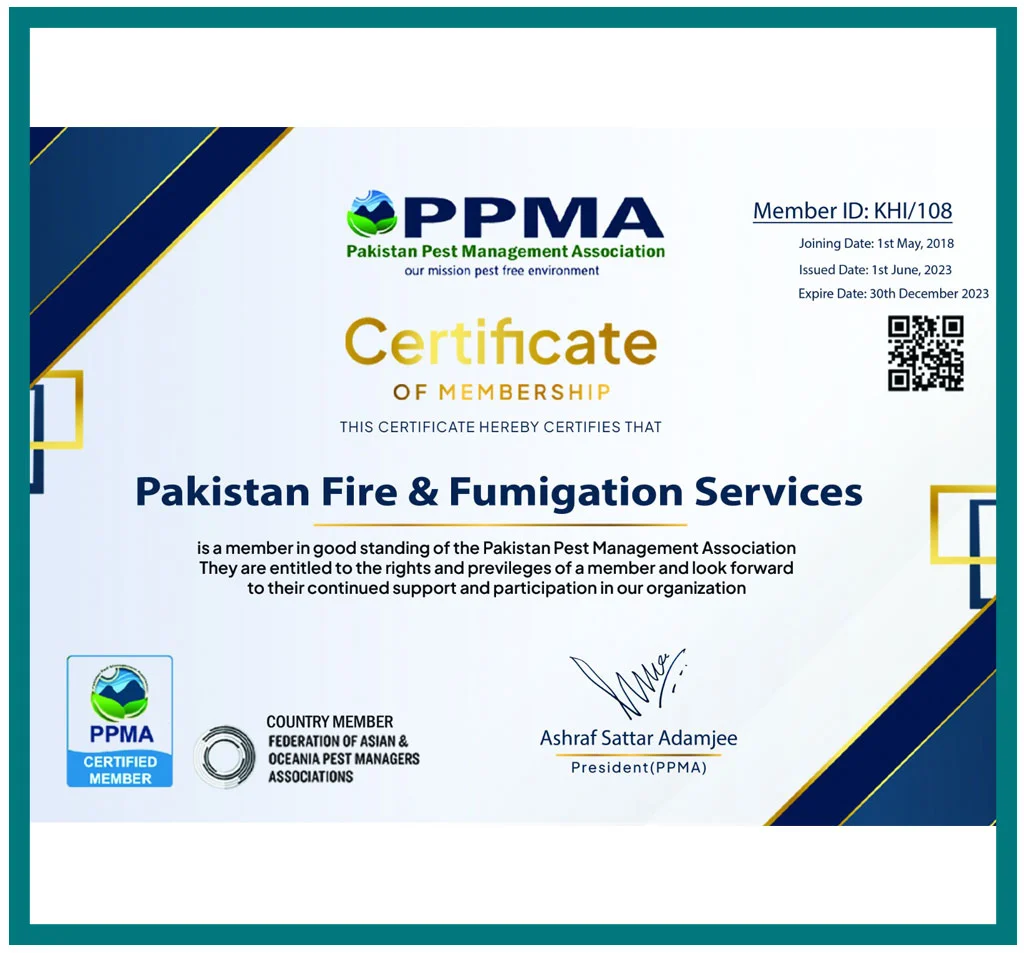
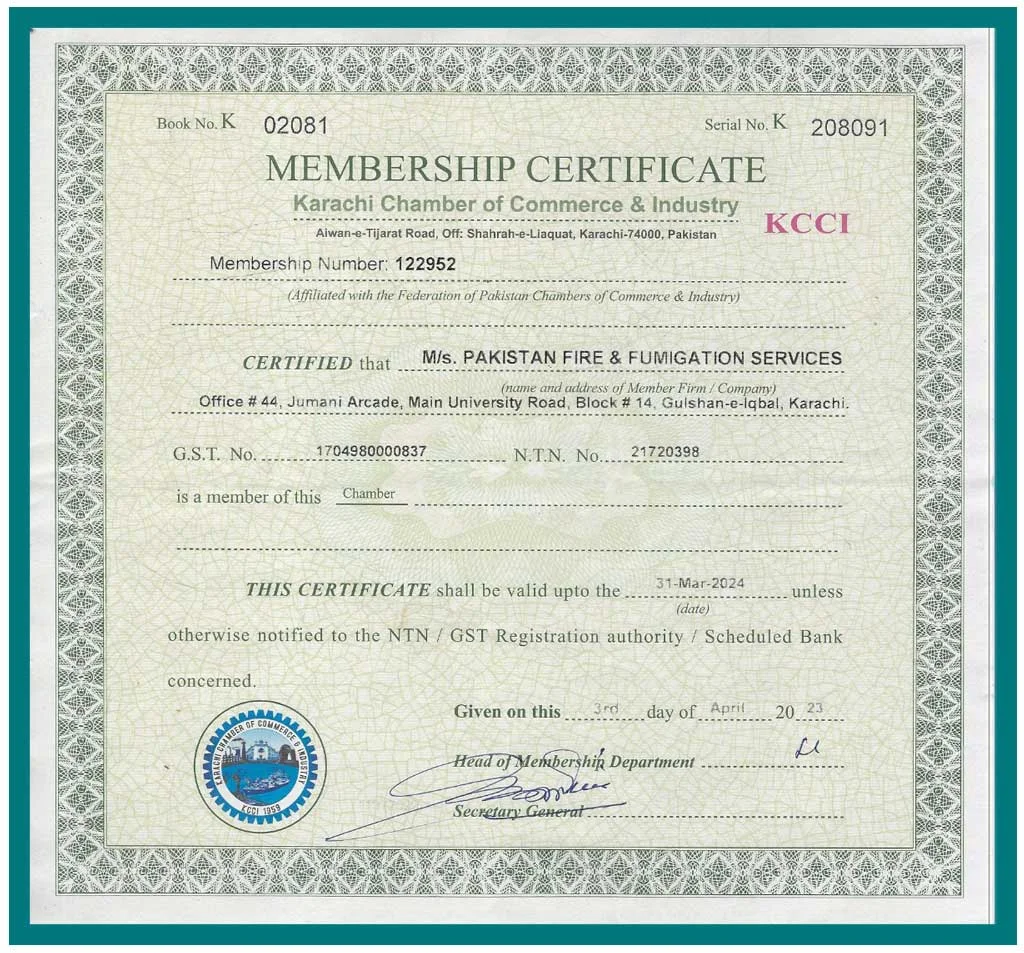
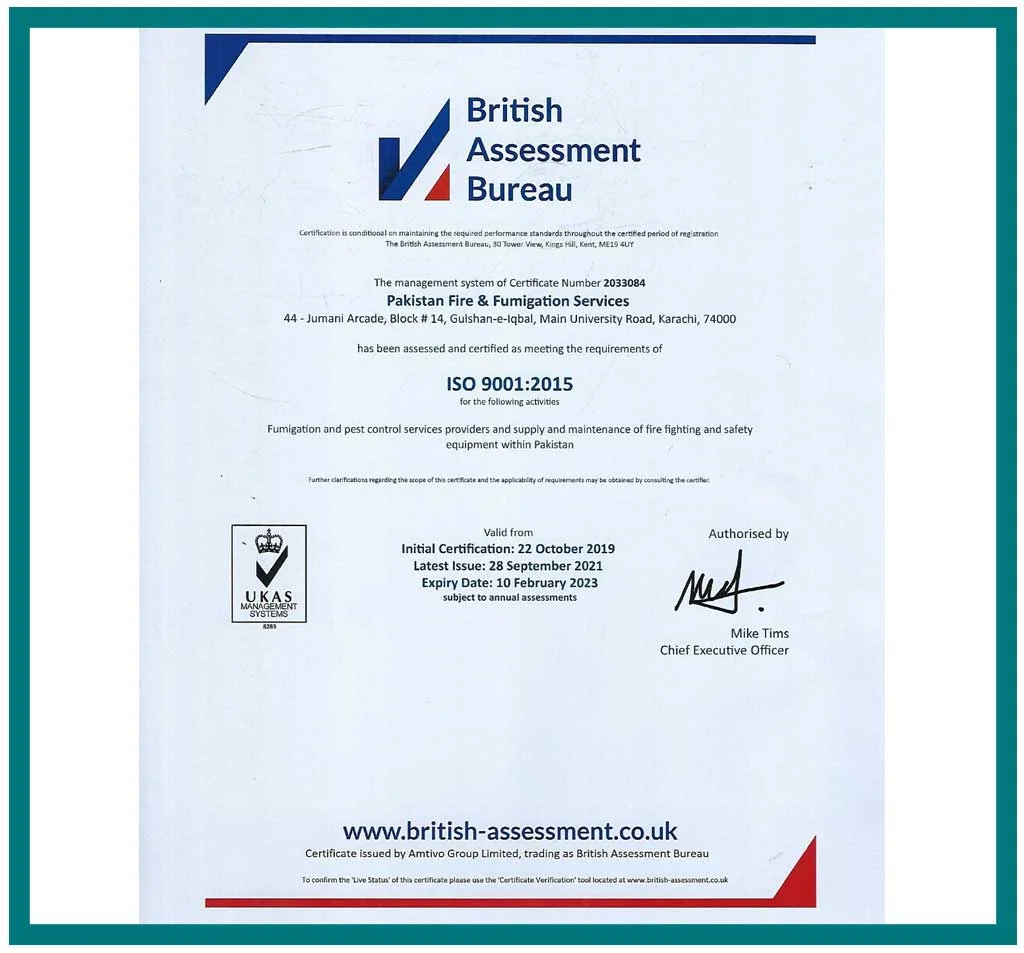
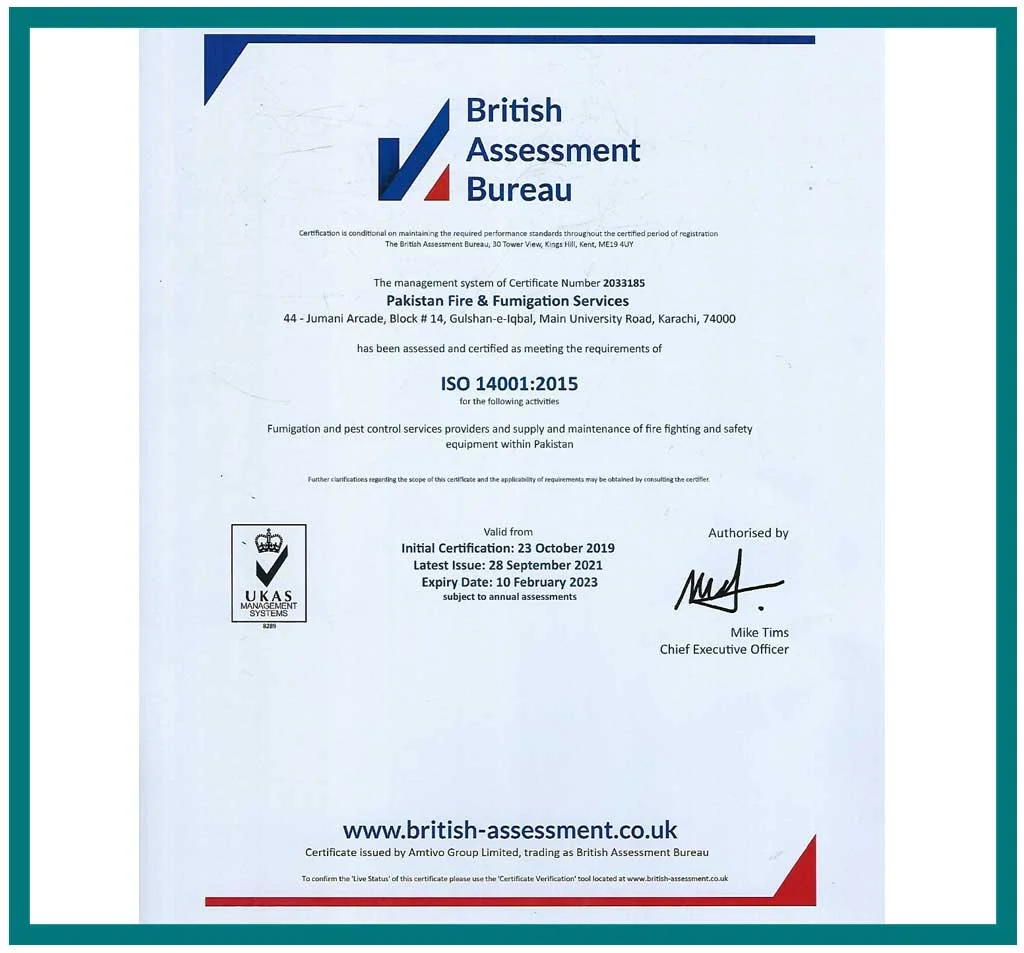
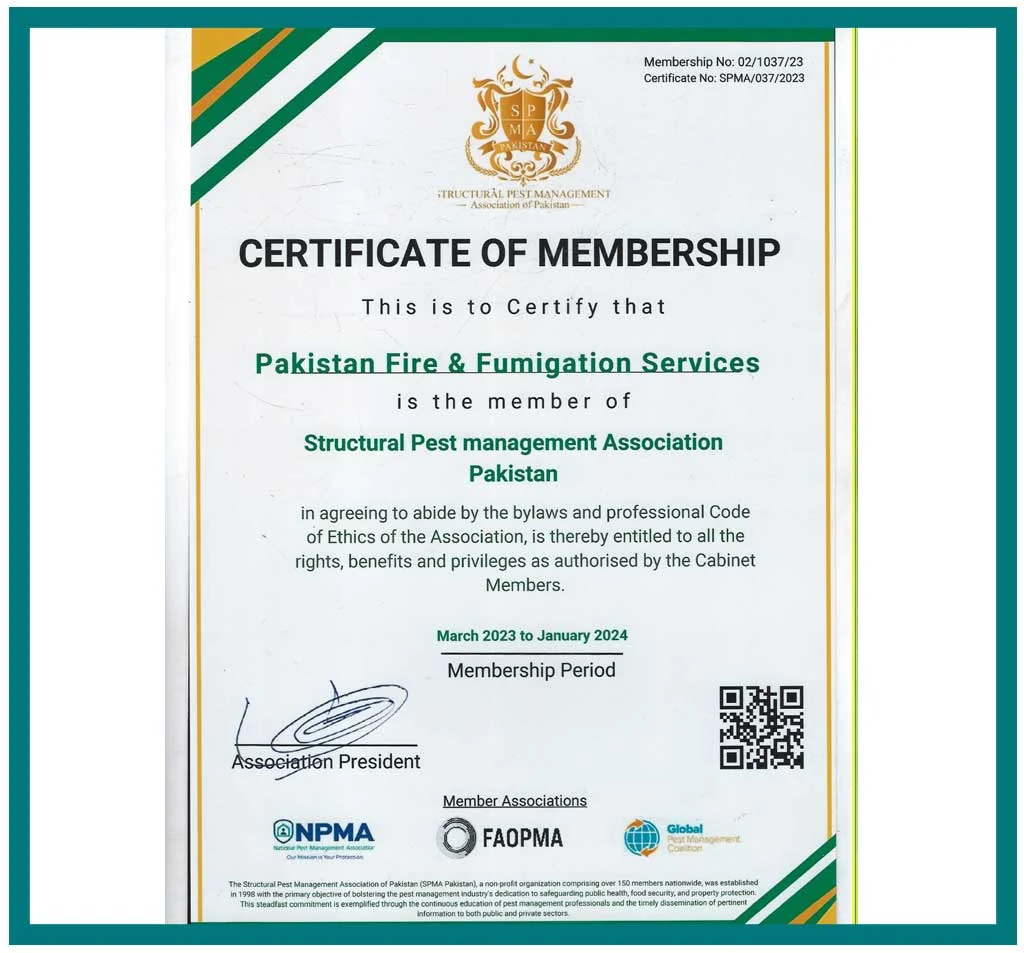
Our Certificates
What Our Clients Say
Muhammad Abdullah — 2022-06-02
Pakistan Fire & Fumigation is one of the best companies, offering mind-blowing customer service across Pakistan.
NAJAM ISLAM — 2022-06-02
Best fumigation in the town i must sayyy
Anas Amir — 2022-06-04
I have tried their fumigation service and hands down they are the best in karachi.
Javed Khan — 2022-06-05
Expert teams and very cooperative staff best work done in my house
Rafay Paracha — 2022-06-06
Best fumigation servies in Karachi! One should really try their services for a healthier environment.
Ahmed Shah — 2022-06-01
Best fumigation in town, I must say!